
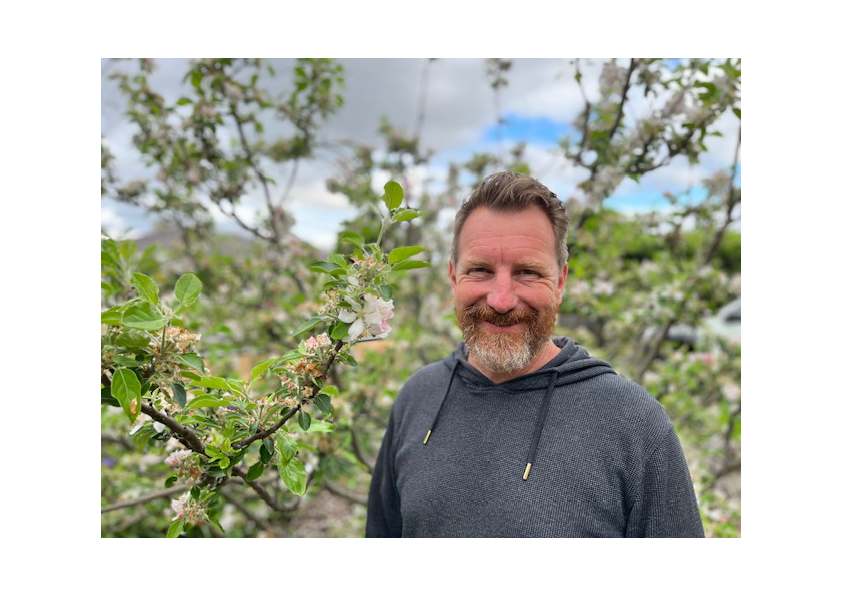
Justin Calverley introduces a new word: petrichor- the fresh smell of rain landing after a dry spell. The kind of fragrance that brings out the oils and earthiness. Often, this evokes a memory stored from early childhood. Justin has held those early memories close, carrying them with him, working as a horticulturalist.
The Urban Food Forester and Urban Farmer author is a lover of trees, the seasons and the rebirth that habitually takes place in the outside world, without our intervention, and despite our losses. In the outside world, life lives on.
Justin’s mum was a child of the depression and post war period, one of fourteen children- as such, she had some nous, growing her own produce. Justin and his siblings grew up amongst the green. They had a free-range youth which was not unusual for the time, out in the garden until the sun came down. As a twin, Justin remembers he and his sister each had an apricot tree. They would climb up and play around them for hours. They could get a good view of the landscape from that vantage point. Naturally, they absorbed knowledge about the plants and animals, as they were part of it, immersed in it.
From a young age, Justin sought comfort in the natural world. If he was hurt or upset as a child, he would find a tree and have a bit of time to himself, maybe cry it out, then, quite suddenly, wonder would take him by the hand. He might have seen a beetle and be lost in its world or warm dappled light drew his attention as he wandered beneath different canopies.
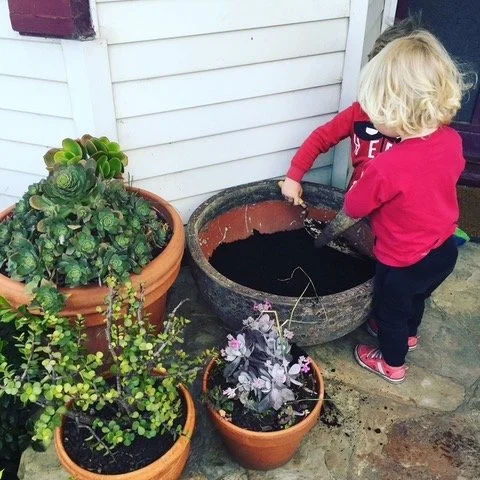
“Nature has always been my comforting place. I feel way more comfortable. You could drop me in the middle of a forest and I would feel absolutely safe.”
They always grew vegetables at Justin’s family home and his mum had a love for flowers so they would sow seeds, waiting to see what sprung up in time.
Still to this day, Justin thinks he can smell a daphne from a kilometre off, such is the familiarity of it. Daphne is his mum’s favourite, that very particular perfume that is a gift in the middle of an often sparse, chilly and overcast winter in Victoria.
Justin remembers planting the seeds for carrots and waiting for them to pop their heads up and be ready. ‘Not quite yet, not yet,’ his mum would say. His preference is still homegrown carrots to any other you might find in a supermarket. For Justin the enjoyment comes from the process, waiting to reap the rewards.
“Just those little moments. That was, for me, 48 years ago and I remember that moment of mum teaching me that lesson. Just magic.”
“Young children already have that sense of wonder and curiosity.”
The gift that accompanies that sense of wonder and curiosity is patience and tolerance, says Justin. Out in the garden, these qualities create great optimism and appreciation.
“It can give you the tiniest little things all the time.”
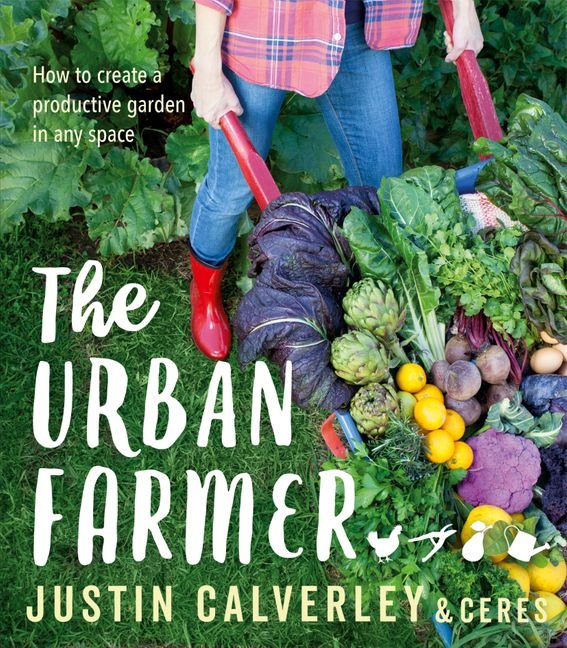
In Justin’s bestselling books, he gets back to basics and the rewards already present in the natural world.
Supporting life in the local ecosystems bodes well for the overall health of those who live there, including the little creepy crawlies who feed the soil and transport nutrients to trees.
Exposure to diversity in the natural world is of dual benefit Justin explains- to the ecosystems and to humans relying on them.
“I think the number one thing would be, we’ve got to learn to embrace diversity again. As a forest grows, different organisms adapt and mould to the system to form all these connections and the strongest of forests, the ones that have lasted the longest, have very intimate little symbiotic relationships and connections with all kingdoms and all diversity actually embraces diversity. Here’s a little opportunity, are you able to adapt to that and if you can, you’re welcome in here and we’ll just tick away forever.”
Justin has been teaching the tricks of the trade for many years as a horticultural educator, engaging with students and designing garden spaces. He intuitively gets the link between the ecosystems of the outside world and their symbiosis with us- nurturing our own internal ecosystem.
Justin is moved when he talks about his students and how they react when he encourages them to taste an edible flower or get close to a tree, to breathe in the fresh air. Something takes them back, to a place, a memory, or triggers a release, a connection.
“They return back to their childhood for most of the time because you know, in going out- and I’m pretty much a hands on kind of teacher- we do a bit of theory but we’re outside all the time, it’s like, ‘It’s raining, bad luck. You’re going to be gardeners, let’s go.’”
Justin said they may think he is a weirdo when he hands them a feijoa petal to taste, but then they get it:
“So give them a petal and just that expression that comes on their face, it’s kind of like what I mentioned before about a young child seeing that seed just pop through.”
“You can see the five-year-old in their face, that sense of amazement. That is incredible. 'How did I get to 45 and not know this?’”
“That’s the pleasure of why I still teach, to be able to give people of all ages- to reignite- that sense of wonder and curiosity and how nature is beautiful and it only gives. It gives to us, gives to us every single day. It’s not something that takes or asks anything from us.”
Justin believes that gardening doesn’t need to cost an exorbitant amount to produce and cultivate. He teaches his students that nature doesn’t produce waste. There is a place for most offcuts. Even weeds, he said, are trying to do their thing.
“The simplest act of recycling any organic material in your gardens is a wonderful thing. Feeding your kitchen scraps to your worms and we use chop and drop rather than composting at home so whatever we prune, we just leave it back on the soil.”
“We put some much pressure on ourselves- it’s got to be perfect, it’s got to be perfect. The natural world is perfectly imperfect.”
Justin talks about the ways that gardens bring people of different ages and cultures together, extending us beyond ourselves.
It is especially important in early childhood. For that, Justin loves seeds: all the variations, colours, sizes. Seeds are an inexpensive way to get plants popping up, if it is the right season.
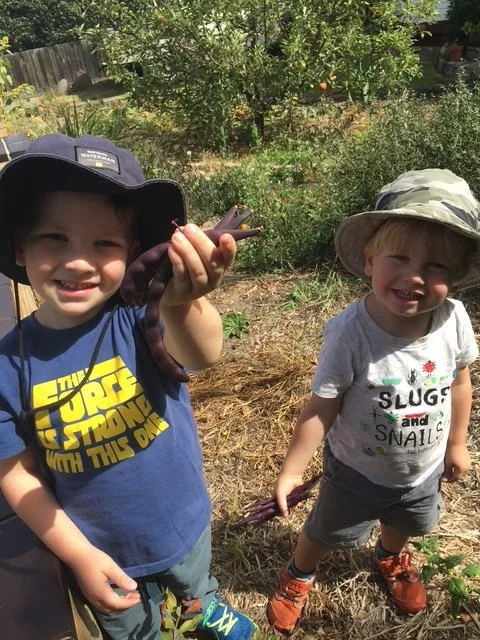
“Just that little crack of the soil, for most young children is that their eyes go wide open and the mouth stops, ‘Oh, I did that’. Now they didn’t really, the plant did it, but you know, they have that connection to it and then they get to watch it grow.”
Justin encourages us all to observe sun patterns, wind patterns, who is coming, what birds, what insects, what lizards.
Justin talks about the simple but effective method of watching the light at different times of the day, at different times of the year. Much like the washing hung outside, it won’t dry all year in the one spot as the light moves, as the earth does its invisible tilt through time.
“All this minutiae of detail, because it’s not smoke and mirrors in the natural world, it’s all happening for a reason.”
“In the plant world they can’t get up and move away so they have all developed these very particular forms and habits to maximise light for where they sit and unless you’re a 30-metre-high tree, you don’t want full sun anyway.
One part of Justin’s philosophy and faith in the natural world is its great capacity to regenerate and also its capacity to withstand the endless change and casualty. Something will grow, eventually.
“Understanding, it is that metaphor for life that, you know, there is going to be great times and there is going to be challenging times. The natural world shows us, yes, the storm there may bring some damage and some, you know, a few scars along the way, but it will move on and things will improve again.”
The life lessons are constant in the outside world says Justin, particularly in Victoria, where the seasons are distinct and moving. Justin jokes that he would like to rename autumn in Melbourne to ‘Spot On’ because he does think the weather is pretty spot on at that time of year.
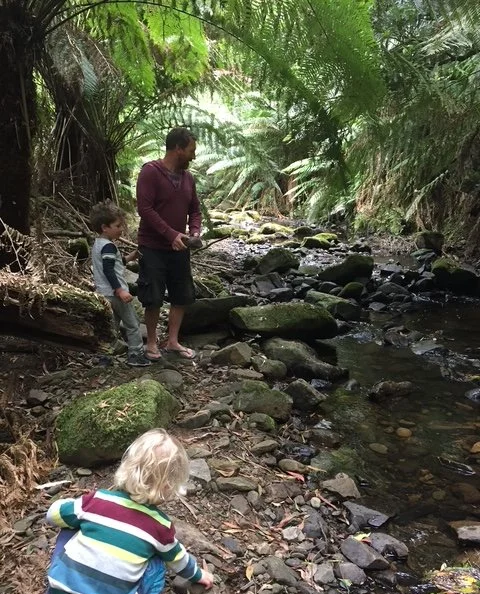
One of Justin’s core design principals is having a place to stop, to sit, to slow down and engage with the garden. He might place a bench in a sunny alcove, create a grassy area for picnics or a smooth rock placed where the birds come: all to gesture, ‘Please sit. Bask. Observe. Chatter. Be.’
“I love that idea of just sitting, being quiet and just softly observing.”
“If in this fast paced world, if you could find 10 minutes a week just to alter your, you know, your weekly schedule a little bit to sit out 10 minutes and I would guarantee that 10 minutes will be half an hour in no time and half an hour will then become an hour and there you go.”
And what is it, that relief or sense of steadiness one is given when spending time in natural spaces:
“That biophilia kicks in. It might just be one moment. They’re out just walking and asking themselves all these, you know, really intense questions and a magnolia is in flower and it captures them- it’s like, ‘Wow, I wonder if I could have that every day’ and that’s something that I share with my students.”
Justin loves how children get to choose what floats their boat in the outside world- a beautiful thing to be able to offer young children as a way to explore and express themselves.
That is one of the key things that Justin loves about a garden: that is a reflection of the gardener. It’s personal and artistic.
“I think that is where gardens, which are art, I believe, they are art too, even if one doesn’t call themselves an artist, they are an expression of who you are.”
It is legacy, too. Planting something that grows on. To share a cutting with a friend, to move a plant from one house to another, to plant a tree that may well live for hundreds of years.
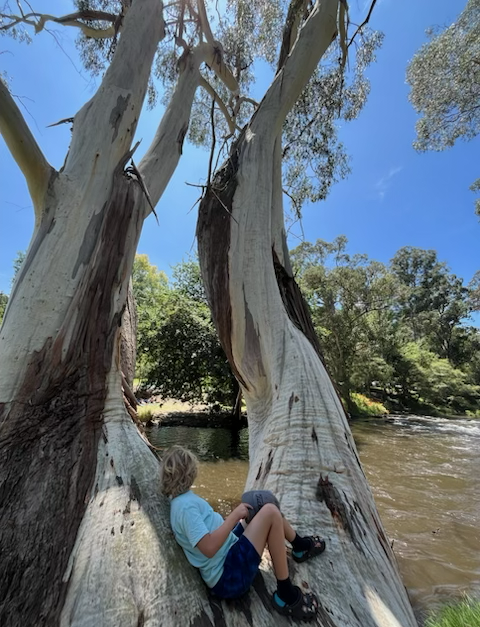
“Leaving a living legacy in the form of plants, that in 200 years time some little five-year-old is going to rub up and climb on that tree and it’s the one that you planted.”
“Imagine as families with our little kids that plant a tree and they get to see it and they grow up and plant one with their own kids. Let’s just keep doing these things. Let’s just keep going and giving every single little one that exposure to the natural world.”
The legacy of life lives on, in nature, through us and with us.
“We just hand that on.”
Hear the full interview with Justin Calverley on the podcast, For the Love of Play.
Listen Here on Spotify
Listen Here on Apple Music